|
DESCRIPTION
An insightful selection about the High Holy Days will add depth and sanctity to your experience of the Days of Awe.
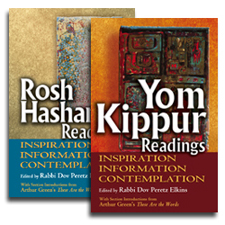
These powerful collections of writings about the Days of Awe help create a bridge between the words of our ancestors and the meanings, themes and ideas that are the central spiritual agenda of the life of the modern Jew.
Drawn from a variety of sources—ancient, medieval, modern, Jewish and non-Jewish—these readings, prayers and insights explore the opportunities for inspiration and reflection inherent in the subjects addressed on the Jewish New Year and the Day of Atonement: sin, repentance, personal and social change, societal justice, forgiveness, spiritual growth, living with joy and hope, commitment to high ideals, becoming our truest and most authentic selves, deepening our capacity to love and savoring the divine gift of life. These readings enable you to enter into the spirit of the Days of Awe in a personal and powerful way while they uplift and inform. They will add to the benefits of your High Holy Day experience year after year.
PRAISE FOR
YOM KIPPUR READINGS & ROSH HASHANAH READINGS
“Provides a treasure-trove of reflections, narratives, and meditations relating to the themes of the High Holy Days. A resource for clergy and laypersons alike as they prepare for public services and an invaluable work for personal reflection. Highly recommended.”
—Dr. David Ellenson, president, Hebrew Union College–Jewish Institute of Religion
“Full of wonderful material that will deepen the Yom Kippur experience for rabbis and their communities. An ever-flowing spring of thoughts and prayers to help us approach Yom Kippur with meaning, creativity, soulfulness and blessing.”
—Rabbi Naomi Levy, spiritual leader of Nashuva and author of
To Begin Again and Talking to God
“Filled with inspirational readings that are profound, and that will challenge and ignite the mind and heart alike…. Will deepen the High Holy Day experience for every reader.”
—Rabbi Joseph Telushkin, author of Jewish Literacy and The Book of Jewish Values
“A truly marvelous collection.... Despite close to sixty years of experience with Rosh Hashanah, I learned and felt things in reading this book that I have never known or felt before—and you will too!”
—Rabbi Elliot N. Dorff, PhD, Distinguished Professor of Philosophy, University of Judaism, and author of The Way Into Tikkun Olam (Repairing the World)
“If you want to spend Yom Kippur (or the months leading up to it) in the company of some of the best Jewish spiritual writers of our time, this is the book for you. Amidst the beautiful and wise passages collected here, you are sure to find something to open your heart.”
—Rabbi Nancy Fuchs-Kreimer, coauthor of Judaism for Two: A Spiritual Guide for Strengthening & Celebrating Your Loving Relationship
“Like a spring that courses through the desert, there are life-giving waters here. Beneath the surface gleam scattered gems from great teachers, to nourish the spirit during the Days of Awe.”
—Rabbi Rachel S. Mikva, editor of Broken Tablets: Restoring
the Ten Commandments and Ourselves
“Those seeking meaning for living from Judaism will find this High Holy Day anthology offers spiritual nourishment for every Jewish home.”
—Rabbi Goldie Milgram, author of Reclaiming Judaism as a Spiritual Practice: Holy Days and Shabbat
“Provocative…. Stressing in straightforward language the themes of Yom Kippur, this will be valuable to laypeople who want to prepare for that day. The wide variety of impressive sources confront us with what should be our serious concerns on that day (and on other days) in the framework of our lives.”
—Rabbi Jules Harlow, editor and translator of Mahzor for Rosh Hashanah and Yom Kippur and author of Pray Tell: A Hadassah Guide to Jewish Prayer
| | | |
|
Reader Comments:
Submit a Comment
"These short readings were perfect to share with my family. I come back to these books again and again and always find something new."
SUBMIT A COMMENT
|
RABBI DOV PERETZ ELKINS BIO
Rabbi Dov Peretz Elkins, a lecturer, educator and author, is rabbi emeritus of The Jewish Center of Princeton, New Jersey, and a former member of the Committee on Jewish Law and Standards of the Rabbinical Assembly and the Council for Jewish Education. He has written widely for the Jewish and general press and is also the author of The Wisdom of Judaism: An Introduction to the Values of the Talmud (Jewish Lights). His website is www.wisdomofjudaism.org.
Q&A WITH RABBI DOV PERETZ ELKINS
 What was your goal in compiling these books?
As a congregational rabbi I have been conducting High Holy Day services all my professional life—for over forty years. On Rosh Hashanah, the services can last from three to six hours, depending on the synagogue. And on Yom Kippur, services begin at sunset and often continue (with the exception of sleep time at night) the entire following day—up to sixteen hours! These Days of Awe are considered by our tradition to be the most important days in the Jewish calendar.
The trouble is that while most people have a general idea of what the purpose of the Days of Awe is, they have very little understanding of the individual prayers that they hear and recite for all those long hours. To spend so much time reciting prayers in a language (Hebrew) that one does not understand, with content that is often couched in difficult poetic format, and always is very challenging to comprehend, makes this important period in the Jewish calendar thorny for most worshipers. Even some who pray in English, or read the translation when the congregation prays in Hebrew, can have great difficulty grasping the deeper meanings of most of the prayers.
Some fifty years ago, Rabbi Abraham Joshua Heschel, of blessed memory, wrote something that, unfortunately, still applies today: “People who are otherwise sensitive, vibrant, arresting, sit there aloof, listless, lazy…. They recite the prayerbook as if it were last week’s newspaper.”
My solution to this ever-present challenge has been to do one of two things in these volumes: I either give a short explanation of the meaning or history of the prayer prior to its recitation, or I offer a reading, poem, or a story (midrash) that embellishes the essential thesis of the prayer. The result is that the worship service becomes a deep spiritual experience instead of the mindless recitation of a meaningless mantra.
What criteria did you use in making the selections of what to include in these new anthologies?
Most of the material comes from Jewish sources—the Jewish thinkers, writers, poets, and teachers who have pored over these prayers for years are the most qualified to write about them.
Among the Jewish sources I have selected are ancient, medieval, and modern writers, including many contemporary rabbis who had the same experiences I did in trying to make the prayer experience more meaningful to their congregations.
On the other hand, I have not hesitated to selectively use writings by non-Jews—philosophers, poets, and playwrights—who have written things that are related in theme to the prayers that are recited. Such writings expand the context and enhance the canvas of the subject that is dwelled on.
Can you give an example of how some of the prayers and rituals of the High Holy Days are enhanced by using the readings you include in Yom Kippur Readings and Rosh Hashanah Readings?
Let’s take the ram’s horn, or shofar, for example. The shofar is sounded several times during Rosh Hashanah services and at the end of Yom Kippur. Yet very little is included in most High Holy Day prayer books (Mahzorim) about the meaning and purpose of blowing the shofar. The chapter on the shofar in Rosh Hashanah Readings contains over twenty pages of material that give personal stories, midrashic and Hasidic explanations, and modern interpretations.
In just one selection, the late Rabbi Hershel Matt, a master teacher and beloved rabbi, elucidates twenty-four different formulations of the meaning of blowing the shofar. As explained in the book, there are twenty-four days during the month of Elul, the month preceding Rosh Hashanah, when the shofar is blown at the conclusion of the daily morning service to prepare people for the coming holidays. Each explanation can be offered on one of these days. Or they can be used during Rosh Hashanah itself. Look at what a broad perspective a worshiper gets by absorbing the varied nuances of meaning explained in this extraordinary list. This selection takes up just two pages (pp. 171–172) of a book of 366 pages. Multiply the value of the two pages by the total number of pages in both books, and you can readily see how enhanced the spiritual experience can be by reading and studying this two-volume set of readings.
DISCUSSION QUESTIONS
Download a printable version
- What themes during the High Holy Days are most meaningful to you?
- Discuss a certain holiday experience in your life that was especially meaningful to you. Why did it resonate with you?
- In what ways, if at all, do you find the prayer leader’s interpolations, readings, and explanations helpful to you? Or do they interrupt the flow of the service? Are you one of those who would rather read about the prayers by yourself in advance, rather than have them read during worship? Or do you reap benefit from hearing something about a prayer before it is recited? Discuss your personal preference for learning and talk about why you think this is so.
- How do you think people change after experiencing High Holy Day services? Do they? Or do you find that resolutions are made, as on New Year’s Day, that are ignored shortly after? What, do you think, are the causes for this?
- What place do you think Judaism attributes to the concept of “sin,” as compared with other traditions?
- Do you prefer to take the words of a prayer literally? (“Who will live and who will die?”) Or do you prefer to look at and understand the phrases poetically and metaphorically? Discuss your answer and explore why you interpret words the way you do.
- Which do you prefer: to know the history of a prayer—such as the authors and their backgrounds and the historical context in which a prayer was composed—or do you find such information irrelevant to the meaning of the words? Alternatively, would you prefer to find out more about how the meaning of a prayer in the prayer book (Mahzor) might be interpreted for our contemporary generation?
- Do you think the actual words move people during the High Holy Days, or is it the music that is most significant in causing the desired emotional effect? What most moves you during the High Holy Days?
- How does the length of a service affect you? How do you deal with the fact that High Holy Day services are often very lengthy?
- What is one thing which prayer leaders could do to enhance the prayer experience during the High Holy Days? Discuss how this would change the experience for you.
CONTACT THE AUTHOR
PURCHASE BELOW
|
|